
01 / INFRA
HISTORICAL PROFILELocal Kubernetes, unpacked.
Study a three-VM Vagrant + VirtualBox cluster, kubeadm bootstrap, CNI setup, and scheduling concepts—without renting a cloud cluster.
Explore cluster setupBuild systems. Observe behavior. Discover what works.
A hands-on laboratory for exploring ROS 2 on Kubernetes — from containerized robotics and DDS networking to scaling, monitoring, and meaningful experiments.
NEWStep through four research scenarios — animated, synthetic, no unverified numbers.
One control plane and two worker VMs in the historical VirtualBox network. Diagram is illustrative, not live telemetry.
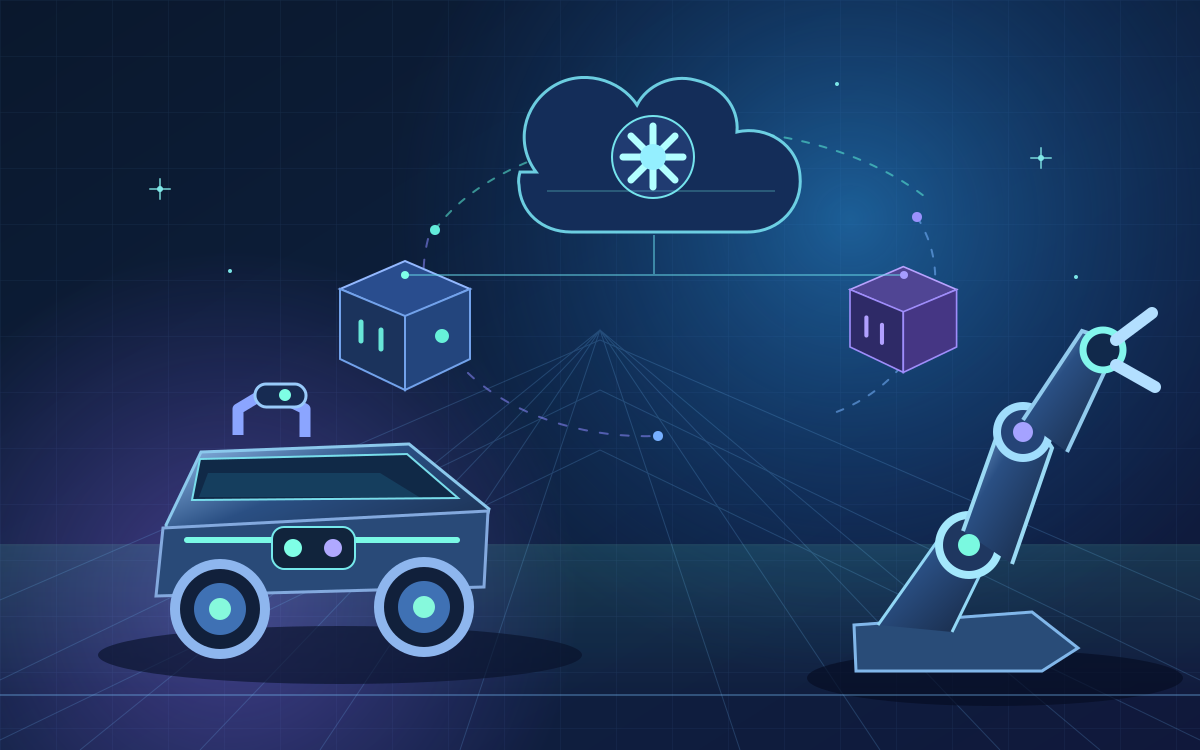
ILLUSTRATIVE CONCEPT ART / NOT A DEPLOYMENT DEMO
From a local Kubernetes control plane to the messages, metrics and experiments that make robotics systems interesting.
Study a three-VM Vagrant + VirtualBox cluster, kubeadm bootstrap, CNI setup, and scheduling concepts—without renting a cloud cluster.
Explore cluster setupBuild the modern ROS 2 Jazzy image and verify talker/listener delivery inside one container. Cross-worker DDS remains a research task.
Explore ROS 2 imageExplore Prometheus and Grafana configuration, autoscaling examples, and Python/Jupyter analysis of historical experiment data.
Explore analysisPurpose-built starting points for teaching, research, and practical infrastructure exploration, each grounded in documented code or open experiments.
Explain containers, ROS nodes, Kubernetes workers and monitoring with a visible topology and documented exercises.
Explore teaching pathStudy DDS discovery, cross-worker behavior, scheduling, failure recovery and reproducible experiment design.
Explore research pathFollow provisioning, containers, historical workload manifests, observability configuration and test boundaries.
Explore engineering pathAnimated, synthetic-only experiment blueprints for Jev, ROS 2, Kubernetes and cloud–edge AI. No unverified performance numbers.
Illustrative, synthetic. A teaching sketch of the pattern the scenarios study, not a running system and not measured data. The moving dots and the highlight that steps through the stages are decoration; the text above says the same thing. Use Pause motion in the menu to stop them.
Compare synthetic DDS, QoS and Kubernetes incident evidence with an offline rule baseline and an optional Jev advisory classifier.
Design placement experiments around network jitter, resource feasibility, loss of connectivity, action freshness and deterministic safety bounds.
Explore how structured advisory decisions might assist simulated task screening and multi-robot scheduling, with hard gates enforced in code.
Interactive walkthroughs are preauthored teaching illustrations. No Jev inference, cloud experiment or physical robot controller runs on these pages. See the unmeasured results registry or join the open research epic.
A robotics application is more than a container. The lab is structured to help you investigate infrastructure, communication, and observability separately.
Read the DDS guideTwo honest starting points: a tested image-local ROS demonstration, or a historical full-cluster lab requiring substantially more resources.
Requires Docker, an amd64-capable host, and internet for image dependencies. Builds an image and checks local talker/listener communication.
git clone https://github.com/MSKazemi/ros2-kubernetes-lab.git
cd ros2-kubernetes-lab

docker build --platform linux/amd64 \
  --file ROS2/Dockerfile --tag ros-jazzy-lab:local .

docker run --rm -i --platform linux/amd64 \
ros-jazzy-lab:local bash -s < scripts/test-ros2-image.shRequires Vagrant, VirtualBox and a powerful host. The legacy setup requests approximately 30 GB of VM RAM and 18 vCPUs; a fresh install is not guaranteed.
git clone https://github.com/MSKazemi/ros2-kubernetes-lab.git
cd ros2-kubernetes-lab

# On your host (historical setup)
vagrant up
vagrant ssh controlplane

# Inside the control-plane VM
kubectl get nodes -o wide
kubectl get pods -Avagrant up.Start with the field guide, then dive into technical source files in the repository.
Transparent engineering goals, not finished-feature promises. The roadmap focuses on proof, safer defaults, and accessibility.
Repeatable talker/listener communication across different Kubernetes workers.
Track issue #14 02 / TARGETEvaluate maintained CNI options and explicit discovery with meaningful tests.
Track issue #15 03 / TARGETExplore a planned kind/k3d entry point for smaller developer machines.
Track issue #16 04 / TARGETMeasured DDS, recovery and scaling experiments with raw evidence.
Track issue #18Each phase has its own page with an animation, the issues behind it and what done means. Interested in future edge robotics and AI experiments? Share a scoped proposal; those integrations are not part of the current validated lab.
Whether you're a robotics student, ROS 2 developer, cloud engineer, or researcher—there is room to improve experiments, explain concepts, and help more people learn. Start a scoped public proposal for teaching or research collaboration.
Still unsure? The repository README documents limitations, commands, and version history in more detail.
Read full FAQNo. This is an educational/research lab. It is not validated for production deployment, safety-critical robots, or real-time guarantees.
No. The Jazzy image has an automated talker/listener test inside one container. Cross-worker Kubernetes/DDS communication is a separate open verification task.
Yes, the historical Vagrant setup is local and does not require a paid cloud account. It does require substantial host resources—roughly 30 GB of allocated VM RAM and 18 vCPUs—and old dependencies may need repair.
Start with the contribution guide and good-first-issue labels. You can contribute documentation, tests, or analysis without running the full Vagrant cluster. Claude Code and Codex instructions are available but optional.